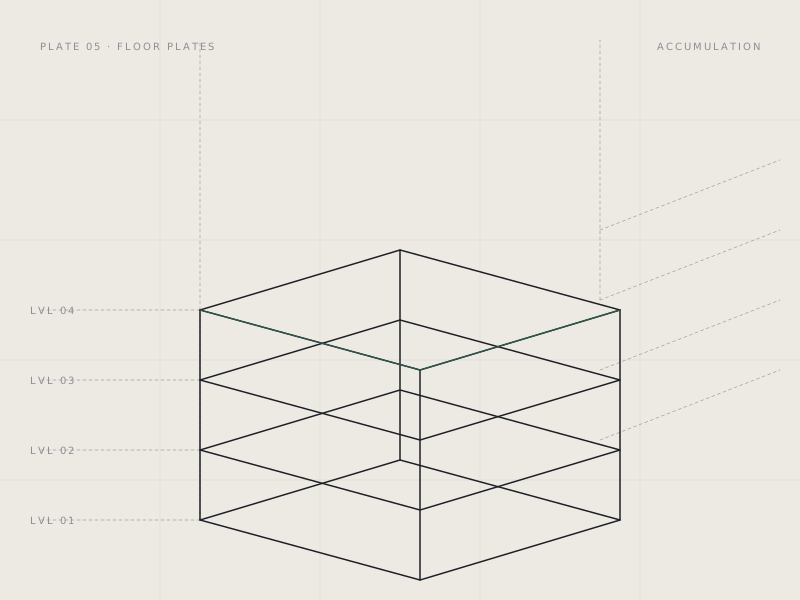
Archetype Flagship 03 — IP
Your team ships. Your company has nothing to show for it.
Turning an engineering team's output into intellectual property that creates, develops, scales, and monetizes as an asset — not a line item.
What you're facing
Your engineering team ships reliably. On paper the technology works. The problem you haven't been able to name until recently is that none of the work coming out of engineering is accumulating. You're spending a third of your payroll on technology and getting no appreciating asset in return.
When your next valuation event arrives, there will be nothing in the data room that makes the company worth more than a services business.
What the work looks like
Create
Structuring your team to produce IP systematically rather than accidentally. Innovation cadence, research discipline, protecting what's made, avoiding IP hygiene problems that bite later.
Develop
Product architecture that treats your IP as first-class. Platform-versus-feature decisions that keep pieces separable and licensable.
Scale
Maintenance model, team structure, ownership clarity — how your IP compounds or decays with use.
Monetize
Commercialization architecture, patent strategy where applicable, licensing and spinout optionality, funding model that supports the full road.
The question underneath
Innovation is IP production.
"Innovation" as a word has been hollowed out by overuse. The operational question underneath it is concrete: what IP did your team create this year, and what is it worth? That reframe replaces vague aspiration with a specific diagnostic you can act on.
What you actually want
Someone who can look at your team's output, tell you what's IP-bearing and what isn't, restructure the work so IP accrues systematically, and stay long enough to make that the new default rather than a project.
What you've already considered
Fragmented specialists who don't coordinate — a patent lawyer who knows nothing about your product architecture, a dev shop that introduces IP hygiene problems silently, a grant consultant whose work quietly pulls research directions away from commercializable outcomes.
Each specialist does their own job correctly in isolation. The problem is that nobody is integrating across them, and the cost shows up 18 months later as an IP asset that doesn't work as a platform, can't be licensed cleanly, and was partly funded by a grant that restricted how it can be commercialized.
2Lines operates across the whole road from idea to profitability and keeps the pieces in alignment — so your IP is actually an asset at the end.